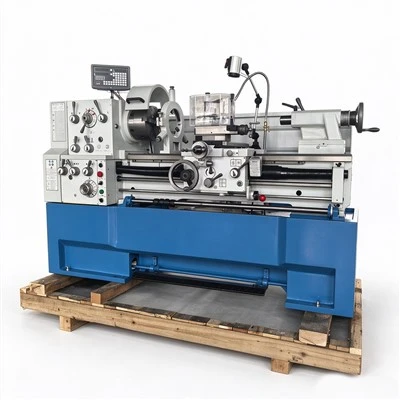
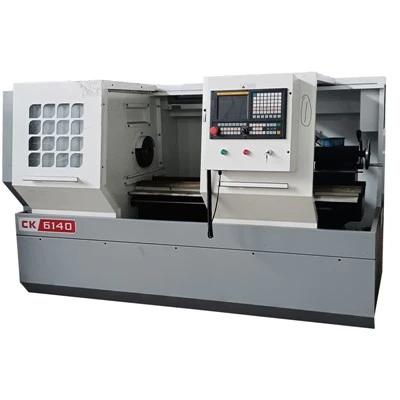
The slant-bed CNC lathe is a high-precision, high-efficiency automated machine tool. Equipped with a multi-station turret or a powered turret, it is capable of machining complex workpieces-including straight cylinders, tapered cylinders, arcs, various threads, grooves, and worms. Featuring linear interpolation, circular interpolation, and various compensation functions, it is ideally suited for the mass production of complex parts.
The advantages of the slant-bed CNC lathe are as follows:
The slant-bed CNC lathe offers high machining precision. Its transmission lead screw is a high-precision ball screw; the transmission clearance between the screw and the nut is minimal-and the smaller this clearance, the higher the precision. This translates into superior repetitive positioning accuracy and overall machining precision for the slant-bed CNC lathe.
The structural layout of the slant-bed CNC lathe directly influences the clearance in the X-axis ball screw. Gravity acts directly along the axial direction of the lead screw, effectively reducing the backlash during transmission to nearly zero. In contrast, the X-axis lead screw on a flat-bed CNC lathe is not subject to axial gravitational force, making it impossible to directly eliminate this clearance. This constitutes the inherent structural advantage regarding precision possessed by the slant-bed CNC lathe.
The slant-bed CNC lathe possesses excellent rigidity and is less prone to vibration during cutting operations. Its cross-sectional area is larger than that of a flat-bed machine of equivalent specifications, resulting in superior resistance to bending and torsion. On a slant-bed machine, the cutting tool approaches the workpiece from an angle above and cuts downward; the cutting force aligns closely with the direction of the workpiece's gravity. Consequently, the spindle operates with relative stability, minimizing the risk of cutting-induced vibrations. Conversely, during cutting operations on a flat-bed CNC lathe, the cutting force generated between the tool and the workpiece acts at a 90-degree angle relative to the workpiece's gravity, making it more susceptible to vibration.
Due to the influence of gravity, the slant-bed CNC lathe is less prone to chip entanglement around the cutting tool, thereby facilitating efficient chip evacuation. Furthermore, when combined with a centrally positioned lead screw and protective sheet metal covers for the guide rails, the design effectively prevents chips from accumulating on the lead screw and guide rails.