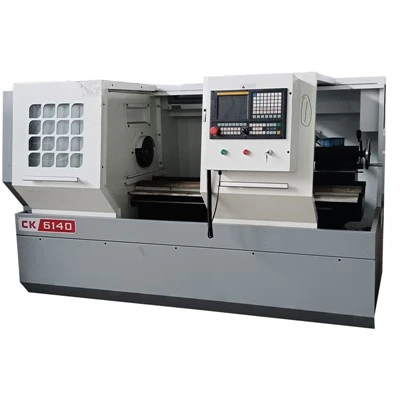
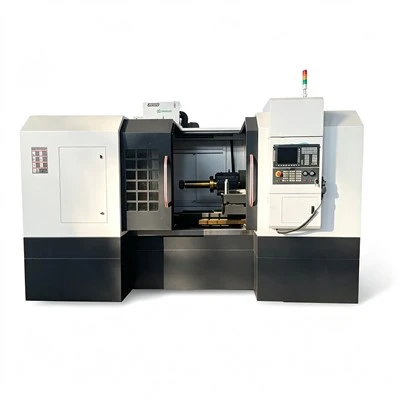
Crankshaft grinders are used in manufacturing plants and repair shops for automobiles, tractors, and diesel engines to grind the crankpin journals and main journals of engine crankshafts. They offer advantages such as high precision, high efficiency, reliable processing, and ease of operation.
So, how should we address crankshaft deformation during operation?
1. The "repair size method" is a common technique for restoring worn mating parts. It involves machining one of the mating parts to restore its correct shape and achieve a new repair dimension, then selecting a matching part of the appropriate size to restore the functional fit. For crankshafts with minor wear, grinding can be used to bring them to the required repair dimension.
2. Crankshafts exhibiting bending deformation must be straightened prior to grinding. Crankshaft grinding is typically performed on specialized crankshaft grinders. In addition to meeting technical specifications for journal surface dimensional accuracy and roughness, the process must also satisfy geometric tolerance requirements: grinding must ensure the coaxiality of the main journal and connecting rod journal axes, the parallelism between these axes, the limitation of crank radius errors, and the precision of the angular spacing between connecting rod journals.
3. For connecting rod journals, either the eccentric grinding method or the concentric grinding method may be used. The concentric grinding method maintains the position of the connecting rod journal's axis after grinding-meaning the crank radius and angular spacing remain unchanged. This method is commonly used for diesel engine crankshafts.
4. The eccentric grinding method involves positioning the workpiece based on the worn surface of the connecting rod journal. Consequently, the position of the journal's centerline and the crank radius both change; typically, the crank radius increases after grinding, leading to a higher compression ratio and uneven variations across cylinders. Furthermore, the crankshaft's center of mass shifts away from the centerline of the main journals, causing imbalance and generating additional dynamic loads during rotation.
5. Therefore, when grinding the connecting rod journals, the increase in crank radius should be minimized, and the coaxiality error between the axes of corresponding connecting rod journals must be kept within ±0.10 mm to ensure the crankshaft remains balanced during operation.