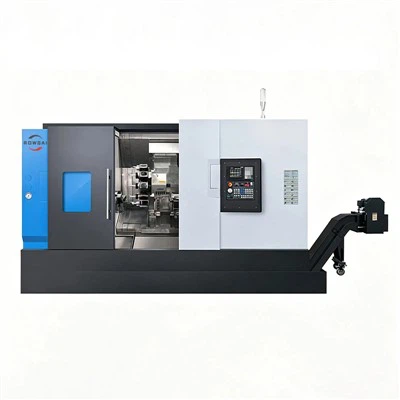
Flat-bed CNC lathes feature a horizontal layout design and represent a classic model within the field of CNC machining. Compared to structures such as slant-bed lathes or vertical lathes, the structural characteristics of the horizontal bed offer significant advantages regarding compatibility with foundation construction and the ease of horizontal installation alignment. This layout ensures that the machine's load is distributed horizontally across the ground surface, thereby reducing the complexity and cost of foundation construction. Furthermore, it simplifies and streamlines the horizontal leveling of the machine tool-as well as subsequent re-inspection and calibration-ensuring both installation stability and operational reliability. By shortening the installation and commissioning cycle and fitting seamlessly into standard workshop layouts, the flat-bed CNC lathe stands as the preferred choice for small to medium-sized machining workshops.
The horizontal layout of the flat-bed CNC lathe results in a low center of gravity and uniform load distribution across the entire machine. This places less stringent demands on foundation load-bearing capacity and construction standards, thereby significantly reducing the difficulty of foundation work. The horizontal bed maximizes contact area with the foundation plane, ensuring that the machine's total weight is distributed evenly across the base without generating localized stress concentrations. Unlike slant-bed machine tools-which often require specialized load-bearing reinforcements or angled foundation treatments-the flat-bed lathe can be installed on a standard hardened concrete foundation that meets conventional requirements.
Foundation construction for a flat-bed lathe simply requires ensuring that the ground surface is level and hardened to standard specifications, with proper control over flatness and load-bearing strength. There is no need to pour specialized bases or construct angled support structures; the construction process is straightforward, the timeline is short, and the cost is low. For workshops utilizing standardized foundations, extensive structural renovations are unnecessary; simple surface leveling, moisture-proofing, and anti-settlement treatments are sufficient to ensure the stable installation of the flat-bed CNC lathe, making it compatible with the existing site conditions found in most workshops.
Moreover, the balanced load distribution inherent in the horizontal layout mitigates the adverse effects of uneven foundation settlement. This places less demanding requirements on the foundation's resistance to deformation; even if the workshop foundation undergoes minor, typical settlement, it is unlikely to induce significant deformation in the machine bed. Consequently, this minimizes precision deviations caused by foundation-related issues, thereby providing a robust guarantee for the long-term operational stability of the machine tool.
The horizontal structure of a flat-bed machine tool makes the leveling process intuitive and straightforward. It requires no complex fixtures or tedious fine-tuning; standard personnel can easily complete the calibration tasks, significantly boosting the efficiency of both initial installation and subsequent re-inspections. During installation, one simply needs to utilize standard measuring tools-such as spirit levels and dial indicators-along the bed's horizontal guide rails, the spindle axis, and other reference surfaces to quickly assess the machine's levelness and visually read any deviation values.
The calibration reference for a flat bed is singular and clearly defined, adhering strictly to a logic of planar horizontal leveling. By simply adjusting the height of the foundation leveling pads, one can progressively correct any horizontal deviations in the bed. This eliminates the need to simultaneously manage calibration across multiple angles and inclined planes, thereby preventing the cumulative errors that can arise from superimposed calibration deviations. In contrast to slant-bed machine tools-which require the simultaneous correction of both horizontal and inclined reference planes-the calibration process for a flat-bed machine is more streamlined and less time-consuming, allowing for rapid installation, calibration, and commencement of production.
The convenience of this horizontal layout for calibration remains equally prominent during subsequent machine maintenance and precision re-inspections. When periodically verifying the machine's levelness, the original calibration reference points can be directly reused to quickly diagnose any issues regarding precision drift. Deviations can be corrected simply by making minor adjustments to the leveling pads, without the need to dismantle any machine components; this ensures that normal production schedules remain uninterrupted and results in lower long-term maintenance costs.
Beyond lowering foundation requirements and simplifying the calibration process, the horizontal layout of a flat-bed machine ensures long-term precision through stable, horizontally distributed load bearing. The uniform distribution of load across the foundation minimizes issues such as bed deformation and guide rail distortion. When combined with the ease of horizontal calibration, this ensures that the horizontal alignment of the machine's spindle and guide rails consistently meets required standards, thereby guaranteeing the dimensional accuracy and surface finish of turned workpieces.
Furthermore, machine tools with a horizontal layout are easily compatible with standard anchor bolts and vibration-damping pads. This further optimizes the foundation's vibration-isolation capabilities, mitigating the impact of machining vibrations on precision while ensuring that the calibrated accuracy is maintained for a longer duration. Whether for the installation of a new machine, a facility relocation, or routine precision maintenance, the advantages of the horizontal layout effectively reduce the complexity of installation and maintenance tasks, offering a solution that is both practical and economically efficient. The horizontal layout of flat-bed CNC lathes-characterized by minimal foundation requirements and streamlined calibration procedures-effectively addresses the practical demands of both initial installation and subsequent maintenance operations. By simultaneously reducing site modification costs and enhancing the efficiency of commissioning and upkeep, this design represents an exemplary fusion of machine tool structural engineering, site adaptability, and operational convenience.